Fantasy Cricket Strategy: Build a Balanced XI in 2026
A strong fantasy cricket team starts with roles, not reputations. Use this match-day framework to weigh player opportunity, conditions and team balance before locking your XI.
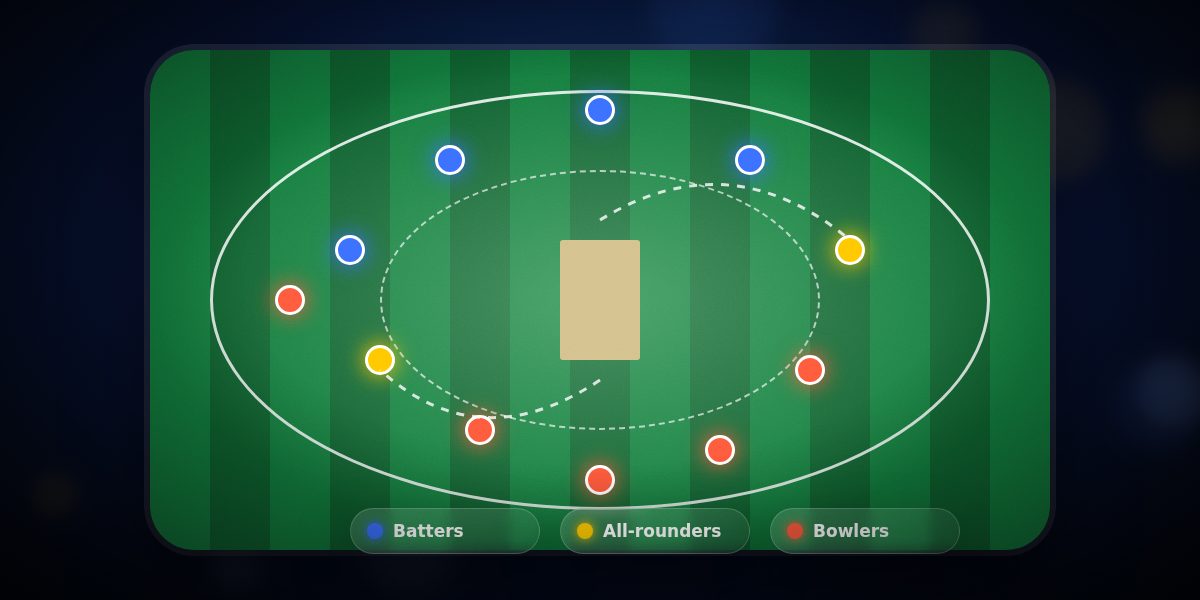
Start with a player's role
Fantasy cricket turns a real match into a team-selection puzzle. Before looking at recent scores, ask what each player is likely to do: bat near the top, keep wicket, bowl in the powerplay, handle the middle overs or return at the death. A clear role creates more chances to contribute than a big name with an uncertain place in the game.
For batters, batting position affects how many deliveries they may face. For bowlers, expected overs and the phase they bowl in matter. All-rounders can earn points in more than one discipline, but only when they are likely to get meaningful time with both bat and ball. Check the confirmed lineup and team news before treating a role as certain.
Use conditions as context, not a guarantee
Pitch, venue, weather and the toss can change the shape of a match. A surface with pace and bounce may give quick bowlers a better opportunity; a slower pitch may bring cutters or spin into play. A small boundary can make a clean striker more valuable, while a large outfield can reward placement and running. These are clues, not promises about what will happen.
Look at conditions alongside player role and recent availability. Avoid making a pick from one headline or one previous score. The useful question is whether the expected match conditions give this player a realistic path to contribute under your contest's scoring rules.
Balance your XI around different ways to score
A balanced XI spreads opportunity across the match. Depending on the format and selection rules, that can mean combining top-order batters, a wicketkeeper who bats high enough to face deliveries, all-rounders with defined duties, and bowlers expected to deliver their full allocation. Check credit limits, role limits and any cap on players from one side before you lock the team.
| Player role | Possible route to points | Match-day check |
|---|---|---|
| Top-order batter | More time at the crease and a chance to build an innings | Batting position and confirmed selection |
| All-rounder | Contributions with both bat and ball | Expected overs and likely batting position |
| Wicketkeeper | Batting plus catches or stumpings | Keeping role and place in the order |
| Bowler | Wickets and any format-specific economy points | Expected overs and bowling phase |
Scoring systems differ. Some award points for boundaries, strike rate, economy or milestones; others weigh those events differently. Read the points table for the specific contest instead of assuming the same scoring applies everywhere.
Choose a captain by opportunity
The captain and vice-captain usually receive a scoring multiplier, but the exact bonus depends on the game. That makes the choice important, while still leaving uncertainty: no player is guaranteed a big score. Compare likely involvement, role security and more than one route to points. An all-rounder with a regular role can be a reasonable option; a top-order batter or a bowler with a defined spell may fit better in another matchup.
Do not copy a captain choice just because it worked in the previous match. Recheck the opponent, conditions and confirmed XI each time, then make sure the contest's multiplier rules match your assumptions.
A simple routine before the deadline
- Read the contest rules. Confirm the player count, credit cap, role limits, scoring and entry deadline.
- Check reliable team news. Remove anyone who is unavailable and wait for the playing XI when the deadline allows.
- Map likely roles. Note batting positions, wicketkeeping duties and bowling phases.
- Consider conditions. Use pitch, venue and weather as context, not as a prediction.
- Balance your selections. Avoid depending on one side or one kind of performance to supply nearly all your points.
- Review captain and vice-captain. Pick based on expected involvement and the contest's bonus rules.
- Lock before the deadline. Reopen the team once to check credits, roles and late lineup changes.
Keep the game enjoyable
Fantasy cricket is uncertain, even when your research is careful. Treat predictions as entertainment, set limits on the time you spend, and never assume a result or reward is guaranteed. drem is free to play; the site is intended for adults aged 18 and over. Check local rules before participating.
New to team selection? Read our beginner's guide to fantasy cricket or use the T20 match-day checklist. You can also read the site's frequently asked questions.
Frequently asked questions
What is the best strategy for fantasy cricket?
Start with each player's likely role, the confirmed team and the contest scoring rules. Then balance your XI across players with different ways to earn points.
Should I choose famous players for my fantasy XI?
Reputation alone is not enough. Check batting position, expected overs, current availability and conditions before you select a player.
When should I lock my fantasy cricket team?
Check the contest deadline and, where possible, wait for the confirmed playing XI and toss information before making final changes.
Related reading
- IPL 2027 retentions and trades: what changes for fantasy cricket: Reported deadlines, trades and role changes.
- ODI fantasy cricket guide: How 50-over picks differ from T20.
- Tilak Varma in T20Is: role, form and fantasy cricket: Player analysis from the New Zealand tour.
- Fantasy cricket 2027: a beginner’s guide to your first season: A starter plan for the new season.
- T20 cricket 2027: IPL 2027 dates, auction and fantasy plan: What is reported so far for the 2027 T20 season.
- Fantasy cricket game 2026: beginner’s guide: Learn how points, captains and credits work before you build your first XI.
- T20 fantasy cricket picks guide: A match-day checklist for T20 teams, IPL-style leagues and Pak vs Aus games.
- Team news and match-day decisions: How confirmed XIs and conditions should change your picks.
- India vs New Zealand T20Is 2026 preview: Schedule, squads and key match-ups for the five-match series.
Questions about playing? See the fantasy cricket FAQ or browse fantasy cricket game modes.
Ready to build your XI?
Review the contest rules, choose your team and follow the match on drem.